
When my CEO had to resign
Feb 27, 2026People often talk about embodiment as if it’s an advanced spiritual elective. But it is far more ordinary than that. And far more radical.
By Anne Jablonski
For most of my life, I treated my body like a cheerful, durable sidekick. Helpful, loyal, mildly dramatic, but not upper management. My brain, meanwhile, was convinced it was CEO. It narrated, strategized, overruled. If my body sent a memo, my brain stamped it Noted and filed it unread.
This arrangement worked well enough for a long time. Until it didn’t.
As life unfolded through yoga, nature, Montana, grief, middle age, and an increasing amount of time spent barefoot outdoors, a small realization took shape: my body had been paying attention the entire time. And it was much better at its job than my brain gave it credit for.
What surprised me most was that this wasn’t just about how I taught yoga. It was about how I lived.
Physical and honest
People often talk about embodiment as if it’s an advanced spiritual elective. Something you take once your schedule clears and you finally know how to pronounce interoception. But embodiment is far more ordinary than that, and far more radical.
Embodiment is simply living inside yourself with some degree of partnership.
It’s noticing the flutter in your stomach before your brain constructs a full backstory. It’s sensing your shoulders inching toward your ears and inviting them back down. It’s realizing a tight jaw isn’t a personality trait. It’s data.
Embodiment isn’t mystical. But it is physical, and physical is usually honest. I didn’t learn this through lofty meditation or moments of exceptional discipline. I learned it in real time, mostly while teaching, often while mildly confused.
Why are you doing it this way?
There was a stretch when I’d be lightly demonstrating a sequence in class, my carefully written notes nearby, cues drilled into me by teacher trainings past. On paper, everything made sense. But as I moved, my body would suddenly interrupt with a very clear question: why are you doing it this way?
I rarely had a good answer.
Sometimes the interruption was subtle. A pause that wanted to be longer. A transition that felt unnecessarily fussy. Other times it was unmistakable. A firm internal nudge that said, this is not it.
And then, without consulting my notes or my training or whatever imaginary panel of yoga elders I thought was watching, I’d change the instruction on the fly. No script. No safety net. Just sensation and a willingness to trust it.
Here’s the surprising part. It worked.
Students didn’t look confused or alarmed, but they sure softened. They followed. The room felt more coherent, not less. My body seemed to be saying, with patience, you can feel this. Why are you making it harder than it needs to be? That was when I began to understand that embodiment wasn’t something I was teaching. It was something I was finally letting lead.
Online, I saw plenty of messaging that treated movement as performance. Something you execute well or poorly, something to get right. But the older I get, the clearer it becomes. Movement isn’t something the body performs. Movement is what the body is.
My cues softened
We humans are animals with complex inner weather. And animals move to regulate state. They stretch, shake, curl, expand. None of it is aesthetic. All of it is functional.
Somatic training later gave language to what my body had known all along. Movement is how the nervous system resets itself. It’s our original language. Somewhere along the way, my body developed what I can only describe as opinions. Not dramatic ones. Reliable ones.
A soft lift in my sternum: yes.
A constriction in my ribcage: no.
Heaviness behind the eyes: rest, not productivity.
A restless hum under the skin: move. Outside, preferably.
These signals had been there for years. I had been too busy being reasonable to listen. As I trusted sensation more, my teaching shifted again. My cues softened. “Try this,” instead of “Do this.” “Notice what your breath wants,” instead of “Inhale now.” “Let the movement arise,” instead of “Lift your arm.”
I became less of a director and more of a facilitator. Less technician, more friendly co-conspirator. Teaching became more spacious, and honestly, more fun.
A quiet interior nudge
The more time I spent outside breathing at the pace of trees, wading creeks, watching horizons, the more obvious it became. We’re animals trying to live at a speed our bodies never agreed to. Stress makes more sense when you watch how slowly aspens move. Anxiety makes more sense when you notice how rarely we look at anything farther away than a screen. Fatigue makes more sense when you compare yourself to any non-domesticated creature and realize they nap without guilt.
Embodiment isn’t self-improvement. It’s relationship with sensation, gravity, and the more-than-human world that surrounds and shapes us. Most of us have felt it at least once. A quiet interior nudge. A subtle yes or no that arrives before explanation. We don’t always trust it and so we explain it away. But the body is patient. It keeps sending messages.
And if you ignore them long enough, the body may escalate. It starts gently, with nudges and whispers. But it’s not above stronger measures. Occasionally, this includes rerouting your life to Montana, where there are fewer distractions and only crappy cell service. Just enough signal to know you’re not in charge anymore.
In the end, embodiment isn’t a destination. It’s a way of being with yourself that’s honest, grounded, and surprisingly ordinary. It doesn’t ask you to become someone new. It asks you to remember who’s been here all along. Your body already knows.
Anne Jablonski
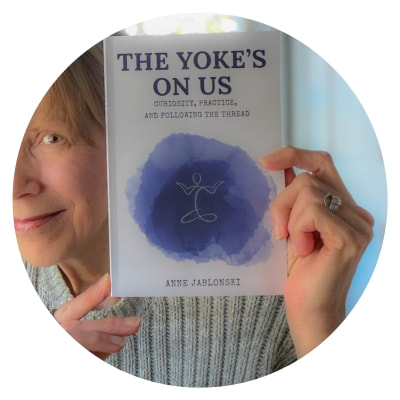
Anne Jablonski is a yoga teacher and a Movingness teacher in Virginia, US.
The text is an excerpt from “The Yoke’s On Us,” by Anne Jablonski, published in February 2026
Paperback available through IngramSpark
Ebook available through major retailers
A deep somatic experience!
Movingness is a new movement method for deep somatic experiences. Curious how it works? Please, try this short sequence and feel for yourself!

Peter Appel is the founder of Movingness. He is also a yoga teacher, dance facilitator, meditation teacher, writer, and mental trainer.
